Somewhere in your drive is a headline nobody objected to, which is not the same as a headline that worked. You had a deadline, so it shipped, and the only person who read it cold was a stranger. What did that stranger understand?
The headline that went live last quarter was chosen because nobody in the room objected to it. I have watched that decision take ninety seconds, and it never gets logged as one. You can message-test an ad set and a landing page, and the sentence carrying the whole offer still gets approved by eye. How many people outside your team have read the last thing you shipped? The copy has to go out on Thursday, so the guess ships, and the only person who reads it cold is a stranger you will never meet.
The copy shipped and nothing broke. That is the part nobody warns you about. A headline half your readers misread looks exactly like one that worked: it loads, it collects clicks from people who were going to click anyway. The version that explained the claim in nine words instead of nineteen is still in a doc with a comment from March. Message testing is the step that would have caught it, and the one step that never makes the calendar.
What Message Testing Actually Measures
Three things, and only the first is easy to collect: whether a reader understood the claim, whether they believed it, and whether they could repeat it back with the page closed.
Preference is the fourth thing you can measure and the least useful. A reader can prefer a headline they misread, because it sounded familiar rather than clear. Ask which headline people prefer and you get an answer in thirty seconds. Ask what the company sells and watch what happens.
Message testing is already answered, badly. The head is full of authority aimed at a different buyer: Gartner's review marketplace listing solutions to buy, the WHO explaining message testing during an epidemic.
Own-traffic methods get named in that field too, on an ICPA guide listing social A/B and email A/B beside five other approaches. Nobody who names them finishes the sentence: no rule for what result ships the copy, no rule for when to stop reading the result, no line about what the method cannot answer. If the copy came out of a messaging framework, this is the next step.
The Three Tests You Can Run Without a Panel
A sequence, not a menu. Each answers a different question, and the cheapest decides whether the other two are worth running.
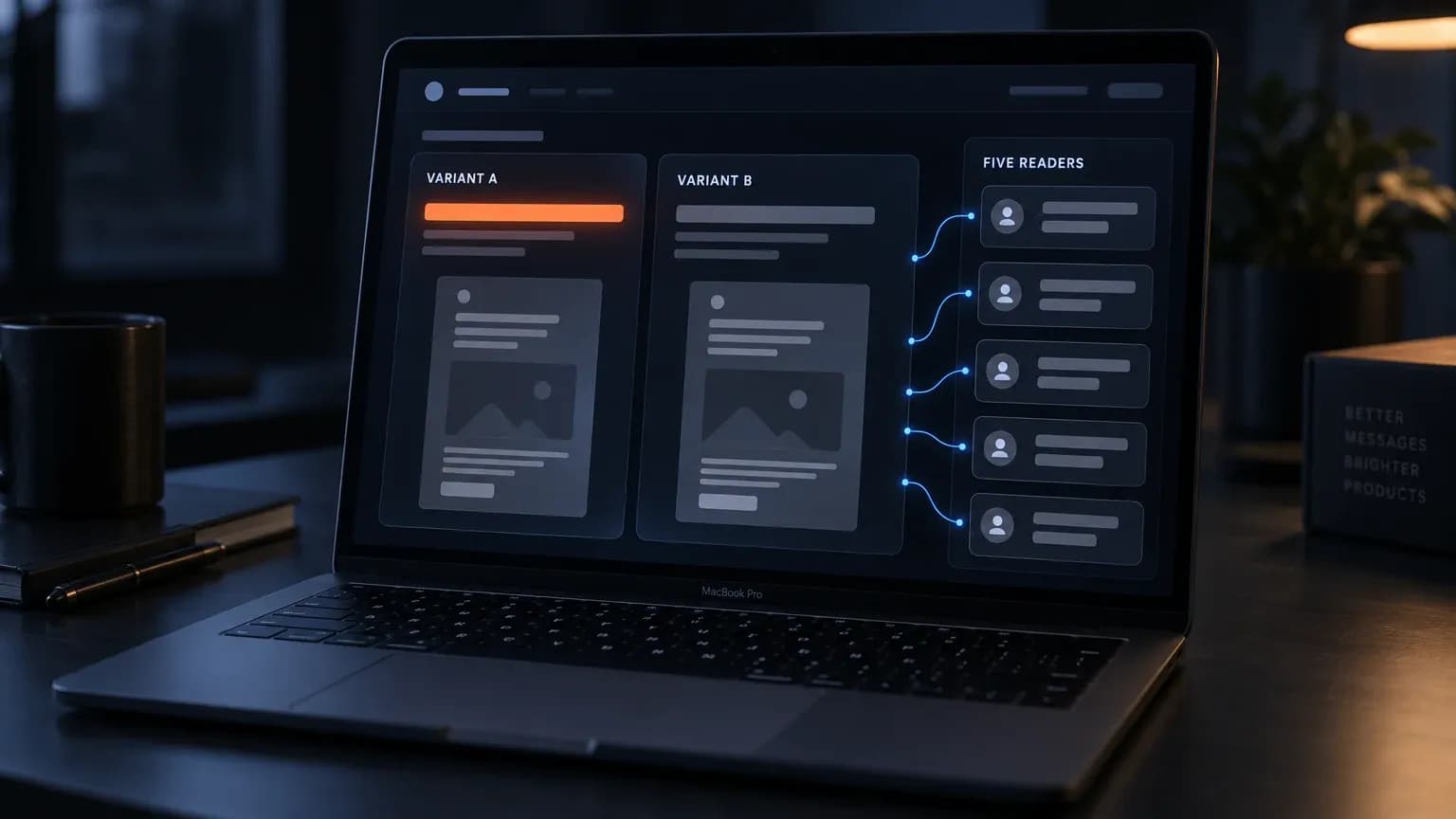
The Five-Reader Copy Read
Five people who do not work for you, half an hour each, five separate conversations. Not a focus group, which produces a social answer when you want the private one.

The number comes from usability research, with conditions attached. Jakob Nielsen wrote in 2012 that if you want a single number, test five users in a qualitative usability study, and the same page lists where that stops being true: 20 or more for quantitative work, 15 per group for card sorting, 39 for a stable eyetracking heatmap. Five is a comprehension instrument, not a law of nature.
Same five questions, same order, every time, then stop talking.
- In your own words, what is this company selling?
- What does this sentence mean to you? (read the value proposition once, flatly)
- What do you expect to happen after you click?
- What part of this did you not believe?
- Which word did you have to read twice?
The discipline is in what you do not do. Do not read the copy yourself, because you stress the words you meant and smooth over the ones that fail. Do not ask whether they like it. Do not explain anything before they answer; if you catch yourself explaining, you tested your explanation.
Two honest clauses. Colleagues and existing users are a biased proxy, and a structured read is not unprecedented: Forthright Advising runs a fifteen minute staff lightning round for the same reason. Yours fixes the question set instead of improvising it, and writes the bias down, with at least three of the five from outside the company. This is not a voice review: you are testing whether the claim landed.
The Headline Swap on One Live Ad Set
Change one thing. The headline. Keep image, audience, landing page and bid identical, or you spend two weeks learning which of four changes mattered.

Google Ads runs this as a real experiment, with a control arm and a treatment arm splitting budget or traffic. Declare the window before launch: fourteen days, a minimum click count you can defend, and what you do if the difference lands inside noise. The answer to that last one is nothing, and writing it down stops you inventing a story about a two percent gap. If the ad set cannot produce enough clicks in the window, it cannot report, and the setup mechanics are in our guide to Google Ads A/B testing.
What you get is attention, and a headline can win the click and lose the reader a page later.
The Two-Variant Landing Page with a Decision Rule Written Before Launch
Google Optimize, the free in-page testing tool, shut down on 30 September 2023 and pointed users at paid vendors. One platform comparison from Articos prices a paid route near $99 a month and pairs the free one with your own list. This is the test you run once the first two agree on a direction.
Write the rule before the variants go live, in one line, in the same doc. If B beats A by at least fifteen percent on the primary conversion across fourteen days with 1,200 sessions per variant, ship B. Otherwise keep A and stop looking. Those numbers illustrate the shape, not a benchmark to copy.
Duration follows traffic, not the calendar. Optimizely's documentation sets one business cycle, seven days, as the minimum and sizes the sample from weekly visitors; the discipline is the part worth keeping. CleverX is blunter about the low end: 10,000 visitors a week produces winners in days, 200 a week needs months.
| Five-reader copy read | Headline swap on one live ad set | Two-variant landing page |
|---|---|---|---|
Cost | Time only: five people you can reach, half an hour each | Existing ad budget, redirected. The platform experiment feature costs nothing extra | Existing traffic, redirected. Free in-page tooling ended with Optimize; Articos puts the paid route near $99 a month |
Time | Days: five reads inside one week | Days to a week of serving, plus the window you declared | Seven days minimum, fourteen if your buyers move on a weekly rhythm |
What it answers | Whether a reader understood the claim, believed it, and could repeat it back with the page closed. Which word caused the confusion | Which of two headlines earns more clicks from the same audience at the same spend | Which of two pages converts better, measured on behavior rather than stated preference |
What it cannot answer | Anything about scale or preference share. Anything causal. Whether the copy sells | Nothing about comprehension or belief, and nothing after the click | Nothing about why. A conversion gap with no read behind it names a winner, not a sentence |
How it fails | Leading questions, or readers chosen because they will agree | Stopping when the number looks good, which is the error Evan Miller names | Peeking, or calling it at a sample the site cannot support |
When a Panel Test Is Worth the Money
A panel buys three things your own traffic cannot: respondents rather than colleagues, control over exposure time, and enough people per variant to compare segments. The designs are specific: monadic copy testing runs 100 to 150 respondents per variant, and a sequential monadic design takes 150 to 200 for three messages, because each respondent sees every variant. Exposure windows run five to fifteen seconds for a headline and thirty to sixty for a value proposition. Live, you never know how long anyone looked.
Four conditions make the spend defensible. The decision is expensive and hard to reverse, like the homepage line or a category name. You need a read on a segment your own traffic barely contains. You need three or more messages compared inside one quarter. The number has to survive a room outside marketing. Outside those four, a panel is an expensive way to answer a question your own traffic could have answered by Friday. If you need recall rather than comprehension, measuring brand recall covers that instrument.
What a Message Test Cannot Tell You
It cannot tell you whether the campaign caused the outcome. A message test reads whether the words worked. An incrementality test reads whether the spend caused the result, and no amount of copy testing substitutes for it.
It cannot tell you the copy will sell, that the offer is right, or that the price makes sense. It cannot tell you why a page converted either: a conversion gap with no read behind it says which page won, not which sentence did the work.
It cannot rescue a promise the product cannot keep, and it cannot help if nobody sees it. Forty clicks a week is a coin toss with extra steps.
How to Read the Result Without Fooling Yourself
Three lines go in the doc before launch: the variant, the number that decides, the date the window closes. Without them, everything afterwards is a story about a number you already saw.
Do not check early. Evan Miller made the argument in 2010 and it has not aged: the significance calculation assumes the sample size was fixed in advance, and repeated checking violates that assumption, so the number stops meaning what it appears to mean.
Treat a spectacular early result as a setup problem. Convert's platform data reports 7.8 percent of completed tests showing a 100 percent plus improvement, and frames it as Twyman's law: results too good to be true usually are.
Then decide what happens if the variant never separates. If the window closes and the versions are too close to call, copy is not the deciding variable, and you choose on something else: which version a cold reader understands faster, which one legal approves without six rounds. Say that in advance and a null result becomes a decision. For the budget-stage version, where exit conditions govern spend, our brand awareness strategy works at another altitude.
With five readers there is no significance to read, so read for pattern: three of five stumbling on the same word is the finding, and five different readings mean the copy is ambiguous. Record the result next to the rule, one line per variant.
Start With Five Readers
I have shipped copy untested more times than I would like to admit: the deadline is real, the test feels optional, and the page goes out. The cost shows up months later as a number nobody can explain.
Take the asset going live next, find five people who are not on your team, and ask the five questions in the same order. Message testing at that size takes half an hour and no budget, and it will tell you more about your copy in a week than a dashboard tells you in a quarter. The headline going out next month will cost more than half an hour either way.
Frequently Asked Questions
Is there a framework for the logistics of message testing, or does everyone just improvise?
No published framework covers the logistics, and the three tests above are a sequence rather than a framework. Where a marketer is asking rather than a vendor answering, the ask is exactly this: "Is there any framework that helps with the logistics of it? Like version control, tracking if it's working etc." A sequence with a written rule in front of each step answers that, and it is not a framework.
How do you keep version control on copy while you are testing it?
One row per variant in one doc: the exact copy, the date it went live, the rule that decides it, the result. Name the file by date rather than final, because there will be a final two and a final three. Record the versions that lost, since that line shows whether a change was ever tested.
How do you know whether a message test is working, rather than just finished?
A test that finished produced traffic. A test that worked answered a question you wrote down before it started. If you cannot name the sentence you would change based on the result, you are collecting data.
What can I do with no research budget and no panel?
Five readers, one fixed question set, half an hour each, this week. It will not tell you which headline wins. It will tell you which sentence nobody understood, which is what makes the other two tests worth running.

Test the Next Thing You Ship
Run the five reads before the copy goes live. Allable holds the research, the draft and the result in one place, so the next test starts from what the last one found.